Barry-Wehmiller Chairman Bob Chapman has said this about the importance of listening:
Time and again, I’ve written that listening is the most important thing a leader can do. But it transcends the leader role. Listening is the most important thing we, as humans, can do for one another. It shows empathy, it shows you care, and most importantly, it shows the person you are listening to that they matter.
We are not taught to listen in our society. So much value is placed on speaking, but not listening. How many listening classes do you see in schools or colleges? They have “speech” classes and debate teams. The skill of listening is special and we need to be taught how to do it well.
Learning the skills to become an effective listener will not only make you a better leader, but a better human being as well
Listening is something we talk about often at Barry Wehmiller, and you've probably heard a lot about it on this very podcast. It’s the foundational class of Barry Wehmiller University, our internal school for our team members. We call this class Listen Like a Leader.
It’s also one of the most important offerings of our consulting company, Chapman & Co. Leadership Institute, as they bring Truly Human Leadership to their clients. And it was the reason Bob and his wife Cynthia created their non-profit, Chapman Foundation for Caring Communities, who brings our listening curriculum to municipal and non profits organizations under the name Our Community Listens.
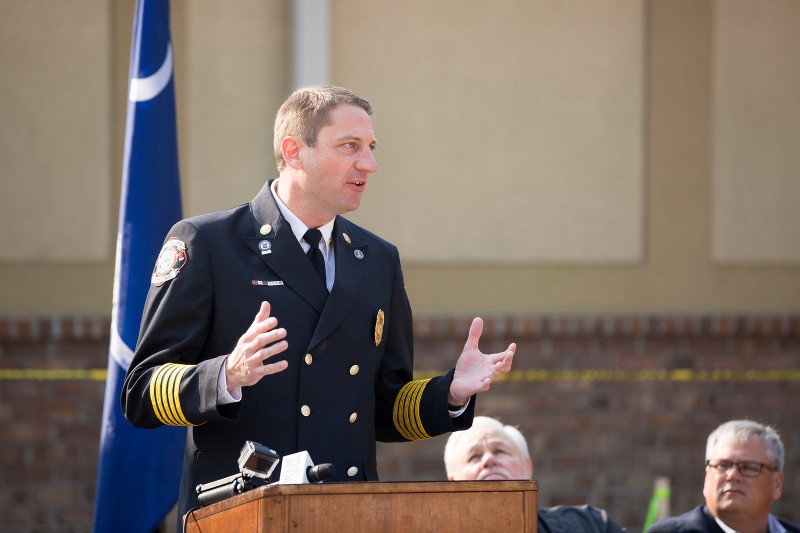
On this podcast, we want to feature an interview with someone our listening curriculum has had a large impact on, Gregory Bulanow, a retired a fire chief in North Charleston, South Carolina. In 2014, Chief Bulanow was looking for training for the leadership of his department and heard about Our Community Listens through word of mouth. After he attended, the chief knew this was something that could make a huge impact on his department and on the North Charleston community.
In his retirement, Chief Bulanow is still a professor bringing our listening curruculm to his community. His story was featured in the revised and expanded 10th anniversary edition of Bob Chapman and Raj Sisodia’s book, Everybody Matters the Extraordinary Power of Caring for Your People Like Family. This interview with Chief Bulanow was dome several years ago before his retirement and he talked about the significance of listening in his work, and he starts off talking about why a class such as this would apply to his department.
Transcript
Chief Gregory Bulanow: I think firefighters are action-oriented people. We solve problems by breaking down doors, dragging in hoses and hitting things with axes. That's what we're trained to do, and we do it well, but that is not the right skillset for many of the issues that we face. Station life and then also home life as well. So, there's aspects of our job in our lives where that skillset does not service well, and I think it leads to a lot of pain. The pressures of shift work, 24-hour shifts, put a huge strain on families for people to be gone for 24 hours at a time. And then just that repeated exposure to emotional trauma I think takes a toll on firefighters as well. It's not just the one incident, but it's the repeated exposure. I think I've often thought that it's particularly cruel to take the most caring people in the world, some of the most caring people in the world who are the people that apply to be firefighters and then expose them to the suffering of others day after day after day.
And unfortunately, that's what happens. And I think we as firefighters need to learn how to talk and listen to each other to deal with these issues because I think the fire service is seeing the consequences for not knowing how to deal with those issues when compared to the general population, firefighters are at significantly higher rates of divorce, substance abuse, domestic violence and suicide, all of those things. And in some cases, significantly higher rates, like two to three times the general population. And these are guys, firefighters will do anything to help another person, especially another firefighter, but they may not put the work in to listen if they don't feel like it's doing something that it's really valuable because we're so action-oriented. We don't think of listening as doing something, but it is so critically important because of what firefighters are exposed to.
So, I think OCL (Our Community Listens, a version of Barry-Wehmiller's listening curriculum) really gives us that skillset. We obviously need to expand our skillset as firefighters. We say we have the greatest job in the world, and I believe that we get the opportunity to help people every day, but it does take the toll. And so, we need to gain the listening skills to be able to take care of one another as well. After I took the class, and I also took it with one other deputy chief, so we met again with Julie, so he and I were both blown away and said, absolutely this is something we want to try and spread throughout our whole department with a primary focus on our supervisors. So, we met again with Julie Chapman and worked out a way to try and train our whole staff, all of our supervisors, and that is 70 people, and we wanted it fast, but we didn't want to detract from the group experience that we had experienced in taking the class.
I thought there was great value in being in the class with civilians, and we didn't want to lose that group dynamic. And we thought if we put too many firefighters in there at one time, that the fire service culture would start to distract from the class experience both for non-firefighters and for firefighters themselves. So, we set up a model where they would essentially hold three slots for us to include three firefighters per class. And we began that in early 2016, I think in January. And since then, we've now trained more than 40 people. So, most all of our upper command staff and also a good group of line officers, and nobody was forced. They all volunteered, they were encouraged by their supervisors, and I think they heard some positive buzz from their colleagues. And afterwards, many of them came to me and thanked me and told me how powerful the training was for them. And that's a very rare occurrence where somebody will have, we do a lot of training and send people to a lot of training classes, but that's a very rare occurrence for somebody to come back and come to my office and ask to speak with me and tell me how valuable it was for them. But that happened many times, and also several of them sent their spouses and friends as well. So that's I think further testament to the value that they experienced.
So, sort of what we saw in how we thought that this would apply to our department is that, as I mentioned, we do a lot of training in the fire service, but most of it is technical training geared toward obviously emergency response, but that's actually less than 10% of our average workday. Even as a very busy fire department, on an average day, less than 10% of our workday is spent doing actual emergency response. So, the other 90% is getting along with other people in the close confines of a station and working together and doing the things that need to be done there. So, we thought, especially for our supervisors, gaining an understanding of our behavioral tendencies and those of others is just extremely important. And I thought there were several elements that really applied to the fire service, that understanding of behavioral tendencies is very important. Understanding the differences and learning the style flex is very valuable. And then listening and really just understanding the value of listening is just so critical within the fire service culture. Important for everybody, but I think especially valuable in the fire service culture because I think that is so hard for a firefighter to accept, but extremely powerful if we do.
Brent Stewart: Chief Bulanow continues by giving a couple of examples of how better listening can impact their day-to-day work, which as he says is not all saving cats from trees and racing and burning buildings.
Chief Gregory: It could be anything from an example of that was there was a lady who owned a business and our fire inspection division was making her install a sprinkler system in a building that she was renovating for business. It was going to be a huge expense. She didn't want to do that, but the fire code was clear it was required. We had made other businesses throughout the city comply with that, but her understanding was that there were other businesses that didn't comply with that. And so, she felt like she was being singled out, and our fire marshal was adamant about that it needed to be done. And she showed me the relevant sections of the code, and I supported her in that requirement. But the business owner was very upset and very frustrated. And so, she came to meet with me, and literally all I did was let her talk, and just listened and tried to use the skills that we had been taught.
And she was just, but yet at the end, she still had to install a sprinkler system, but she had the opportunity to be listened to and feel like I heard her and understood that it was going to be difficult for her, and it was going to be expensive for her. And I recognize that, and I think that's what she needed. After that, we did not have issues with her again, and she complied with the fire code and installed the sprinkler system. That's an external example. Internally, just people being examples where maybe somebody hasn't been eligible for a promotional process due to some issue that they may feel was out of their control. Maybe a class, a required class was canceled, then they weren't allowed to continue in the process. Sitting down and listening to 'em, or perhaps they were denied eligibility. That's an example where someone wanted a letter of recommendation from a member of their command staff, and they didn't get it.
And we're very frustrated by that. They're allowed to come up through the chain and speak to me and gave them that opportunity. And a couple of those guys have gone back out and made sure they had what they need by the next year and have gotten promoted and gone on to be very good fire officers. So, just giving them the opportunity to be heard, not changing my mind, not changing policy, but just it is what it is. It's unfortunate that it worked out the way it did, but for the good of the organization, this is what needs to be done to take the next step. That's something that I think is very difficult for us to do in the fire service as well because we have sort of a unique dynamic there.
It's especially difficult within a fire station because we're all living together like a family. So, for our supervisors there, if the person you have to discipline may be the same person who is cooking your dinner or you're sharing living quarters with, or sometimes sharing a bunk room with, that makes it very difficult if you don't know how to deal with a conflict constructively. So, I think too often in the fire service, we tend to avoid problems until they blow up into a major conflict. And talking with fellow fire chiefs, that's one of the things we see time and again, where so many of the issues that we have to deal with that involve disciplinary action, involving terminations, those types of things are things that could have been nipped in the bud if a line-level supervisor had the skills and the ability to do that. And we see that time and time again, or too often we end up transferring people rather than really getting at the root of the issue. So, I think teaching our officers the way to address conflict constructively and without a lot of drama is just incredibly valuable. And I think any fire chief would, I think, jump at something that provides their staff with the ability to do that.
Brent: When a community is faced with a tragic event involving the very people who are sworn to uphold the law and serve its citizens, it can seem like there's been a breach of trust that oftentimes is very difficult to repair. How can that trust be regained? Chief Bulanow talks about one such incident in his community.
Chief Gregory: I don't want to get too far out of bounds in terms of speaking for the police department and all of that, but we did have an officer-involved shooting, and that was very high profile. And so, that was a real challenge for us. I mean, we were, CNN and all of the news channels camped right outside my office window for a week when that happened. And then that there's all the aftermath of that with some demonstrations. And then there was the trial for the officer, which was there was a hung jury, or I'm sorry, a mistrial. And so, that is still going on. So, we are working through that as a community, and I think OCL can be very helpful in helping us address that. I mean, it comes down to trust issues and relationships. And I think part of why we were able to avoid some of the civil disturbances that other parts of the country experienced was that there was a strong level of trust already established. There was some strong relationships between the city administration and some core contingencies throughout the city, and those relationships held, but they were strained.
And so, we need to be working to try and strengthen those relationships and build new relationships. And I think our police chief has taken the class. He sees value in this, he's sending his officers to attend, and there are others in the city who are taking it as well. So, I think this can be part of that relating to each other, civilians, first responders relating to each other as people, and developing this skillset where you see some of these demonstrations, everyone shouting, nobody's listening, but those demonstrations are people that need to be heard and are finding a way to be heard. And so, by developing these skills, we can all create that opportunity for each other.
Brent: So, how can just a simple class make such a huge difference? Can these skills be applied in more places than just within the firehouse or at home? Chief Bulanow talks about the hope he has for the North Charleston community.
Chief Gregory: We saw this as an opportunity to build relationships, not only build this skillset within our organization, but also build relationships throughout our community with this class. So, when I took it, I was struck really by the strong interpersonal dynamic that formed very quickly so that we come in, group of strangers bonded very quickly and very deeply. We're all talking about the things that are most important to us, our relationships, and that's the same for everybody. So, that bonding experience I think can be very valuable for the right group of people. So, what we've done over the last year or so is we're trying to include a core group of citizens, but then also three firefighters, and we've also included some police officers as well. And this gives the citizens the opportunity to get to know their first responders on a deep personal basis and vice versa.
And many times, I think people may all want the same things. I mean, we all want the same things for our community. The fire service has a role. Police officers have a role. Citizens have a role. And we're all working, and we're working toward a better community. But without the opportunity and the skills to listen to each other, we may end up seeing each other more as adversaries rather than understanding that we're all allies and that we're working toward the same thing. And so, I think we see that OCL can help us change that. We've tried to set it up where OCL can provide the skills and then also the opportunity for these relationships to start. And I think I believe that can be a very powerful thing for our community, not just our organizations, but our mission is our organizations and our impact when we're working together with our community to move our community forward.
I don't know how this is going to turn out for us because it certainly does raise expectations for us as an organization that we are going to be an organization that shows we care for all of our people by listening to each other and by resolving conflict, not with a bat, but with the bended knee.